The Real GTM Playbook: Occasions, Positioning & Channel Physics
Edit on the left, see spacing, line breaks and lists render instantly on the right. Drafts stay in this browser until you send me the markup.
When founders sit down to map out a Go-To-Market strategy, the conversation usually jumps straight to ad spend, CAC targets, and influencer drops. But after two decades of launching products across FMCG, mobile hardware, and tech investments, I can tell you that real GTM is rarely solved on an ad dashboard alone.
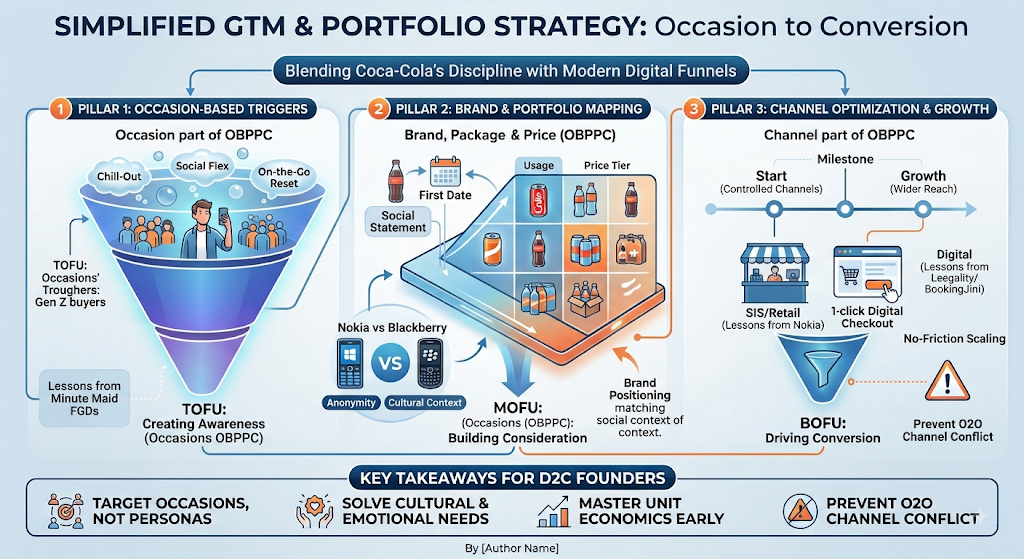
The most resilient approach blends classic consumer discipline—like Coca-Cola’s OBPPC framework—with modern digital funnels.
The Consumer Stays the Same, the Occasion Changes Everything
Back in 2008, working on the GTM strategy for Minute Maid Juice at Coca-Cola, we spent months running Focus Group Discussions (FGDs) analyzing daily cultural routines. That’s where I realized that defining your consumer as a static persona is a trap. The exact same person buying a juice for a quick, functional health fix at 8:00 AM becomes a completely different buyer at 4:00 PM when hanging out with friends.
For Gen Z consumers across FMCG, fashion, or dining, your GTM must target these shifting occasions:
- The Casual Chill-Out — low effort, comfortable, and price-sensitive.
- The Social Flex — high visibility, aspirational, and tailored for content creation.
- The On-the-Go Reset — pure convenience and immediate gratification.
Your product competes within a specific moment. Talk to the person rather than the occasion, and your message falls flat.
Positioning Lies at the Intersection of Brand and Cultural Context
Brand positioning isn't a line in a pitch deck—it is the unspoken job your product does for someone in a specific social setting. Ordering a Diet Coke on a first date is rarely about quenching thirst; it’s a subtle expression of personal style and self-control.
I saw this on a larger scale in 2015 while leading GTM in Saudi Arabia for Nokia and Windows Mobile. On paper, our hardware was competitive, but BlackBerry was dominating because BBM offered a culturally safe layer of anonymity and social currency. BlackBerry wasn't just selling smartphones; they were helping young consumers navigate strict cultural boundaries. Your positioning wins only when it fits the exact social context of the moment.
Channel Physics: Offline Footprints to Digital Funnels
At Coca-Cola, the golden rule was simple: be within an arm’s reach of desire. Later, running over 400 Shop-in-Shops (SiS) for Nokia across South India taught me how physical footprints build local trust, but also how heavy retail overheads erode profitability if store-level economics aren't pristine.
Transitioning to digital distribution—observing Leegality up to its exit and investing in BookingJini—showed me the power of low-friction scaling, but also its hidden tax in rising ad costs and platform dependency.
When you map these channel realities onto modern digital funnels, each stage needs its own discipline:
TOFU — Top of Funnel
This is high-traffic retail placement offline, or viral ad creatives digitally. Both burn cash if they don't hook a specific occasion trigger. Awareness without occasion relevance is just expensive noise.
MOFU — Middle of Funnel
This is in-store sales interactions offline, or retargeting and social proof digitally. Both fail if your positioning ignores the user's immediate social context. The job here is to convert curiosity into preference.
BOFU — Bottom of Funnel
This is frictionless checkout at the physical counter, or one-click digital buying. The only metric that matters is how fast desire turns into transaction.
Expanding offline and digital channels simultaneously without clear pricing boundaries creates immediate channel conflict—a delicate balance that tears margins apart if managed carelessly.
Key Takeaways for Founders
- Target Occasions, Not Static Personas: Map consumer triggers across different times of day, locations, and social settings.
- Solve the Cultural & Emotional Need: Align your brand utility with the social statement your buyer wants to make at that moment.
- Master Store/Unit Economics Early: Whether managing physical Shop-in-Shops or digital ad funnels, protect gross margins before expanding reach.
- Prevent O2O Channel Conflict: Maintain strict pricing and packaging boundaries between physical retail and online touchpoints.
Building an enduring business isn't about a flashy launch weekend. It takes patience, iteration, and proper guidance to avoid scaling before your model is sound. But when occasion, positioning, and channel strategy lock into place together, growth stops feeling like a constant fight—it starts feeling organic.